
Education for Every Child: How School Supplies and Scholarships Break the Poverty Cycle in Nigeria
When a child receives the tools to learn, an entire community moves one step closer to lasting change.
The Hidden Barriers Keeping Children Out of School
In many Nigerian communities, especially in rural and low-income areas, children stay at home not because they lack interest in schooling, but because their families cannot afford the essentials. The cost of exercise books, uniforms, writing materials, examination fees, and transport can quickly become overwhelming for parents who are already struggling to feed their households.
As a result, children rotate between casual labour, house chores, and idle time. Dreams of becoming teachers, nurses, engineers, or community leaders slowly fade as the realities of poverty take over. Without intervention, this pattern is repeated from one generation to the next.
Why a Simple School Kit Can Change Everything
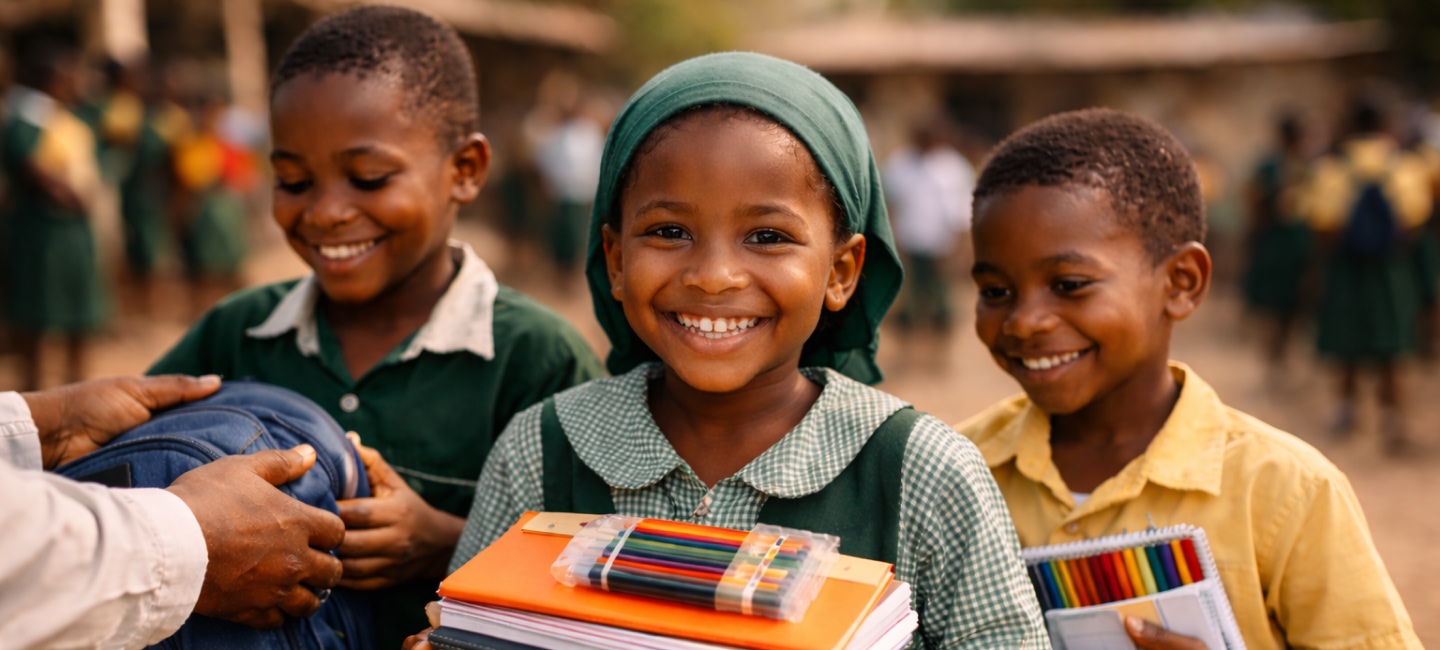
A school kit—containing notebooks, pens, pencils, a mathematical set, and sometimes a school bag—may look ordinary, but it carries powerful meaning. For a child who has never owned brand-new school materials, receiving a kit says, “You matter. Your future matters.”
Children who receive school supplies through the HRM Osana Emmanuel Onyatikpo Elayo Foundation often show:
- Improved attendance: With materials at hand, there is less embarrassment and more motivation to attend classes.
- Better performance: Adequate books and writing tools support homework, revision, and participation.
- Increased confidence: Children feel proud, seen, and supported.
These changes may seem small from the outside, but they gradually reshape how children see themselves and what they believe is possible.
Scholarships: From Surviving to Thriving
While school kits address immediate needs, some children require more comprehensive support. Scholarship programmes cover a wider range of costs—fees, uniforms, textbooks, and sometimes transport—ensuring that bright and determined students from disadvantaged backgrounds are not forced to drop out.
When a child receives a scholarship, the benefits extend beyond the individual:
- Parents experience relief from financial pressure.
- Younger siblings gain motivation when they see what is possible.
- The community gains a future role model with new skills and ideas.
Many scholarship beneficiaries go on to mentor other children, volunteer in community projects, or support their families financially after graduation. In this way, one act of generosity continues to bear fruit for years.
Education and the Poverty Cycle
Poverty is rarely just about a lack of money. It is about limited choices, limited access, and limited opportunities. Education opens doors that poverty tried to keep shut. Literate and skilled individuals are more likely to secure decent jobs, start businesses, participate in civic life, and make informed decisions about health, family, and finances.
When more children complete school, communities benefit from:
- Lower unemployment and higher earning potential.
- Better health outcomes, because educated people can understand and apply health information.
- Stronger voices in local leadership and decision-making.
- Reduced vulnerability to exploitation and early marriage, especially for girls.
This is why investing in education is widely recognised as one of the most effective strategies for breaking the poverty cycle.
Stories of Hope from the Classroom
During a recent distribution, a young girl received her first full set of exercise books and writing materials. She held them tightly and said that she no longer had to borrow torn pages from friends. She could finally write her name on the front cover of her own book.
In another community, a shy boy sponsored through a scholarship programme later emerged as the best student in his class. Today, he talks about becoming a doctor so that he can return and serve the same community that supported him.
These are the quiet victories that show how powerful a simple opportunity can be.
How the Foundation Supports Education for All
The HRM Osana Emmanuel Onyatikpo Elayo Foundation works closely with schools, parents, and community leaders to identify children most at risk of dropping out. Support is offered through:
- Back-to-school drives that provide school kits and uniforms.
- Scholarship schemes for children from the poorest households.
- Mentorship and encouragement to help learners stay focused and motivated.
- Community sensitisation on the importance of educating both boys and girls.
By combining practical support with encouragement and advocacy, the Foundation creates an environment where children are more likely to start school, stay in school, and succeed in school.
You Can Help a Child Stay in School
You do not need to build a school to change a life. Sometimes, all it takes is a school bag filled with supplies, or a term’s worth of fees for a child on the verge of dropping out. Your support, no matter the size, can stand between a child and a lost opportunity.
- Donate a school kit: Equip a child with notebooks, pens, and other basics for the term.
- Sponsor a term or a year: Cover tuition and related costs for a specific student.
- Partner as a corporate sponsor: Fund larger programmes that reach entire schools or communities.
- Spread the word: Share stories of educational support with your network to inspire others.
When you give a child the tools to learn, you give them the chance to dream again. And when enough children dream and succeed, communities are transformed from within.
Education is one of the most powerful gifts you can give. It outlives you, and it outlives the moment.